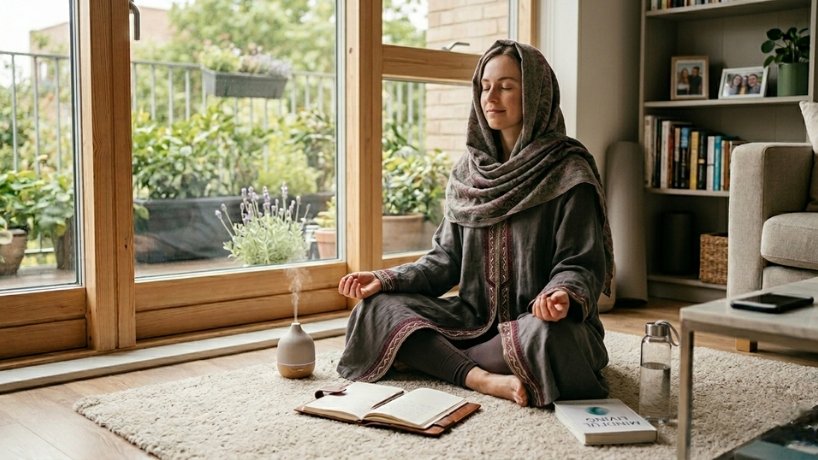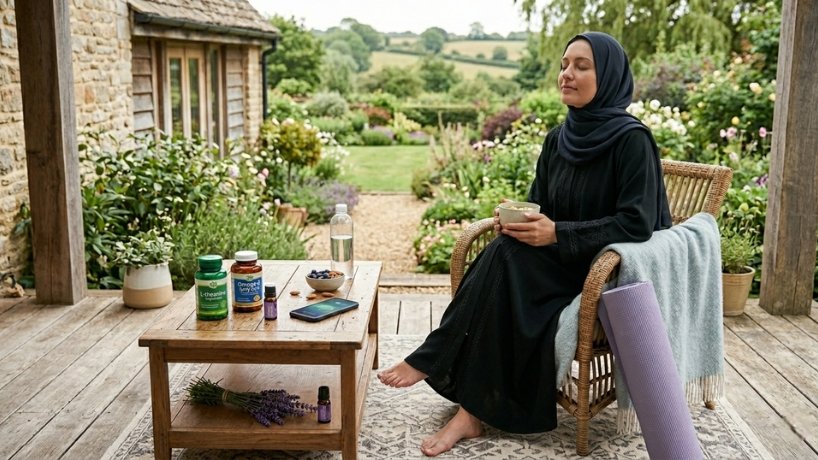
Mindfulness isn’t a destination; it’s a way of traveling. By training your brain to focus on the “here and now,” you create a buffer against the stressors of modern life. Whether you are five or eighty-five, these practices help rewire your nervous system for peace.
For Adults: Infusing the Mundane with Meaning
Adult mindfulness is about reclaiming the “in-between” moments of a busy schedule.
- The “Three-Glimmer” Log: Instead of a long list, find three tiny “glimmers” (moments of safety or joy) and write them down before bed.
- Kinetic Commuting: Feel the vibration of the steering wheel or the rhythm of the train. Observe the landscape as if you’re a photographer scouting for a shot.
- Monotasking Manifesto: Pick one chore (like folding laundry). Turn off all screens. Focus purely on the scent of the fabric and the movement of your hands.
- Sensory Infusion Dining: For the first three bites of any meal, close your eyes. Identify three distinct flavors or textures before swallowing.
- Earth-Contact Gardening: Handle soil without gloves for a moment. Notice the temperature and the weight of the plants.
- The “Bio-Feedback” Walk: Walk at half your normal speed. Notice which part of your foot hits the ground first.
Creative & Group Connections
Mindfulness flourishes when shared or expressed through art.
- Symphonic Immersion: Listen to a piece of instrumental music. Try to “follow” just one instrument (like the bass or the violin) through the whole song.
- Shared Silence: Sit back-to-back with a partner. Try to match your breathing rhythm without speaking.
- The Zentangle Flow: Grab a pen and doodle repetitive patterns—circles, waves, or grids—letting the hand move without a goal.
- Mirror Gazing: Look into a partner’s eyes for two minutes. Notice the urge to laugh or look away, and simply let it pass.
- Abstract Mood Painting: Use colors to represent how you feel right now, rather than painting a “thing.”
- Laughter Catalyst: Start with “fake” laughter in a group. Notice how quickly the body transforms it into genuine, stress-releasing joy.
For Kids & Teens: Making Presence Playful
For younger minds, mindfulness works best when it feels like a discovery or a challenge.
- The Statue Challenge: Wiggle as fast as possible to music, then “freeze” in a pose when it stops. Feel the “tingle” in your muscles.
- Detective Scavenger Hunt: Find one thing that smells like “outside,” one thing that feels “bumpy,” and one thing that sounds “whistly.”
- The Dragon’s Breath: Inhale deep into the belly, then exhale a “huge blast of fire” (a long, slow huff) to calm the heart.
- The Thought Bubble: Imagine your worries are bubbles. Blow them out and watch them drift, wobble, and eventually pop.
- Gravity Defying: Stand on one leg like a heron. Notice how your core muscles work to keep you upright.
- The Sound Map: Close your eyes and point in the direction of every sound you hear for 60 seconds.
High-Speed Calm (5-Minute Resets)
When time is short, use these physiological “hacks” to reset your brain.
- Box Square Breathing: Inhale for 4, hold for 4, exhale for 4, hold for 4.
- The Micro-Scan: Starting at your toes and moving to your jaw, “check in” with each muscle group for 5 seconds.
- The Object Deep-Dive: Pick up a mundane object (like a pen). Study it for two minutes as if you’ve never seen a human invention before.
- The “Room Refresh”: Look around and name 5 blue things, 4 round things, and 3 wooden things.
- Temperature Shock: Splash ice-cold water on your face to instantly “reset” the vagus nerve.
- The Palms-Down Moment: Place your palms flat on a desk or your thighs. Feel the heat transfer between your skin and the surface.
Targeting Tension & Anxiety
Specific tools for when the “fight or flight” response is overactive.
- The Anchor Point: Identify one physical sensation that feels “solid” (like your heels on the floor) and return to it whenever thoughts race.
- Narrative Reframing: Instead of “I am anxious,” say “I am experiencing a wave of energy.”
- The Compassion Pivot: Treat your anxiety like a scared child. What kind words would you say to comfort them?
- Rhythmic Tapping: Gently tap your collarbone in a steady rhythm to ground your physical body.
- The Horizon Gaze: Look as far into the distance as possible. Expanding your peripheral vision naturally lowers stress levels.
- Water Tracing: Run warm water over your hands and focus entirely on the sensation of the flow.
- The “Not Mine” Technique: Label a repetitive worry as “a thought” rather than “the truth.”
- Weight Reset: Use a weighted blanket or a heavy pillow on your lap to provide “deep pressure” input to the brain.
The Takeaway
Mindfulness isn’t about clearing your head; it’s about noticing your head is full and choosing where to place your attention anyway. Start with one “micro-activity” today and watch how the silence grows.